Thousands of cancer patients across Alabama and Tennessee trusted the Bard PowerPort catheter to deliver chemotherapy safely. Lawsuits now allege its core material is chemically programmed to fail, cracking inside the body and sending fragments toward the heart. If your PowerPort fractured or caused a serious complication, our Bard PowerPort lawsuit attorneys at Cory Watson Attorneys can review your case at no cost.
Key Takeaways
- ChronoFlex, the catheter's polyurethane-barium sulfate blend, is alleged to degrade inside the body over time.
- Barium sulfate particles separate from the polymer, leaving stress-concentrating notches that initiate fractures.
- Fractured fragments migrate through the bloodstream toward the heart, lungs, and other vital organs.
- The FDA's MAUDE database contains more than 5,333 adverse event reports tied to Bard PowerPort devices.
- Alabama's AEMLD and Tennessee's Products Liability Act both support design defect and failure-to-warn claims.
The Science Behind PowerPort Failure: Barium Sulfate and ChronoFlex
The PowerPort catheter is built from ChronoFlex AL, a polyurethane compound blended with barium sulfate for X-ray visibility. That chemistry is the defect: barium sulfate does not bond permanently with polyurethane inside the human body. Research published in the Journal of the Mechanical Behavior of Biomedical Materials (PMID 27552159) confirms that the loss of barium sulfate particles from the catheter surface creates microscopic notches and pitting. Those notches become stress concentrators -- the precise points where the catheter cracks under the ordinary pressures of breathing, movement, and medication injection.
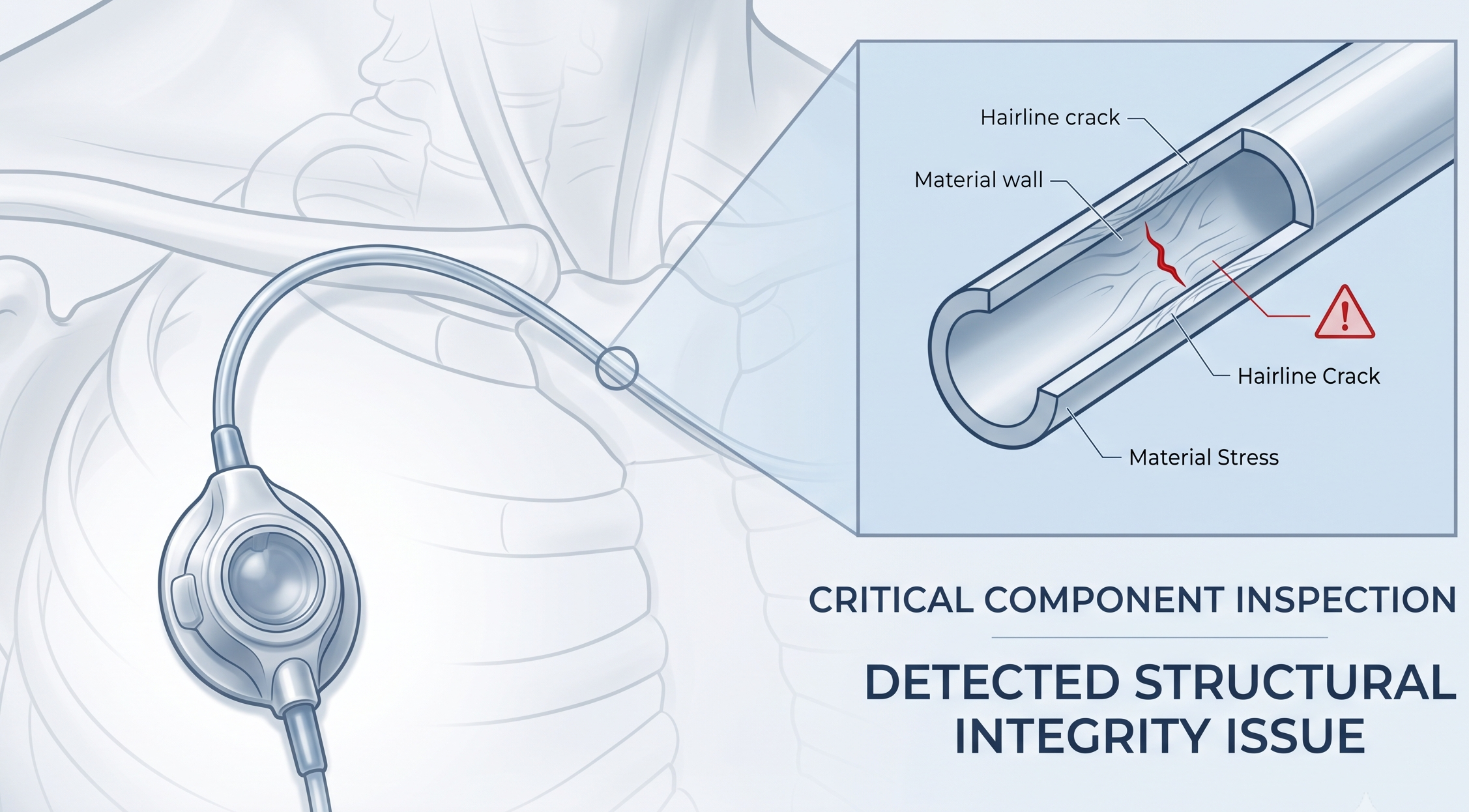
The FDA's MAUDE database records more than 5,333 adverse events linked to Bard PowerPort devices, including fractures, migrations, material separation, and infections. Between December 2025 and February 2026, 438 more were filed.
Why Catheter Migration and Fracture Occur
Once the catheter wall is notched, a fracture is a mechanical inevitability. A broken fragment does not stay put. The bloodstream carries it toward the heart and lungs, where it can cause:
- Cardiac tamponade: debris compressing the heart
- Pulmonary embolism: a potentially fatal vascular blockage
- Cardiac perforation: the fragment piercing the heart wall
- Sepsis: from bacterial colonization of the roughened, pitted catheter surface
Becton Dickinson cleared the PowerPort through the FDA's 510(k) pathway, which requires no clinical trials. Plaintiffs further allege that Bard filed approximately 87% of its adverse event reports through the FDA's Alternative Summary Reporting (ASR) program, a non-public channel that kept injury data hidden from physicians and patients until 2019.
Legal Standards for Design Defects in Alabama and Tennessee
Alabama's AEMLD holds manufacturers liable when a defective product causes injury at the time it leaves their control. Bard PowerPort lawsuits allege all three recognized defect categories: design, manufacturing, and failure to warn.
Tennessee's Products Liability Act makes a product actionable when it is unreasonably dangerous and a safer alternative exists. Neither state requires plaintiffs to prove intent, only that a defective design was chosen and the risk concealed.
See our defective product attorneys page for the full scope of claims our firm handles.
Proving Negligence in Medical Device Litigation
A PowerPort design defect claim requires:
- Duty: Bard was obligated to deliver a device reasonably safe for implantation.
- Breach: ChronoFlex created a fracture risk that a feasible alternative could have eliminated.
- Causation: Your injury resulted from the catheter fracturing or migrating.
- Damages: Medical costs, lost income, and pain and suffering.
Expert testimony from materials engineers and physicians ties the molecular failure to each plaintiff's injury. Contact us today for a free, no-obligation review.
Documenting Your Catheter Complications
Gather now:
- Medical records: implant notes, imaging, operative reports, discharge summaries
- Device identifiers: serial number and lot number from your implant card or hospital file
- Symptom log: dates, complications, and treating physicians
The statute of limitations closes permanently in both states. Act now.
Frequently Asked Questions
What is ChronoFlex, and why does it fail? ChronoFlex is a polyurethane-barium sulfate blend. Particle separation leaves notches that crack under normal physiological pressure.
What happens when the catheter fractures? Fragments migrate to the heart or lungs, risking pulmonary embolism, cardiac perforation, or sepsis, often requiring emergency surgery.
Has the FDA recalled the PowerPort for this defect? No. As of June 2026, no recall covers the ChronoFlex fracture issue, despite 5,333+ documented adverse events in the MAUDE database.
How quickly do I need to act? The statute of limitations varies by state and discovery date. Waiting can permanently close your options.
What to Do Next
More than 3,583 cases are moving through MDL 3081 in Arizona as of June 2026. If your PowerPort fractured, migrated, caused a bloodstream infection, or required surgical retrieval of fragments, visit our firm overview and then contact us today. No upfront fees, we collect only if we recover for you.